- Source, Ron Paul

Tuesday, 12 November 2019
Ron Paul: End of Liberty or End of The Fed, Which Will Come First?


Monday, 11 November 2019
Egon Von Greyerz: Hell Will Soon Be Unleashed In Global Markets
“The gold price is determined in a Casino with massive leverage and it has nothing to do with the real price of physical gold. More about that later in the article…
At what point will gold turn from a minority interest, attracting less than 0.5% of world financial assets to a mass-market investment?
Two Decades Ago We Made This Important Decision…
Three decades ago I identified physical gold as the best asset to hold for wealth preservation purposes. Then, almost two decades ago we decided to invest properly in physical gold for ourselves and the investors we advised. Part of our wealth protection plan was obviously to store the gold outside thearea we saw as the biggest risk, namely the financial system. Anyone who stores gold in a bank, ETF or some gold fund has not understood the purpose of physical gold.
Being holders of a minority asset means that 99.5% of the investment population sneers at you and believes you live on a different planet. As a company who passionately wants to help others to protect their wealth, we are fortunate to meet like-minded people. But most of our clients feel very isolated because they have no one to discuss their concerns about the world with.
I would advise anyone with a gold interest to attend a good precious metals conference. In the last two weeks I have been speaking at two excellent gold conferences. One was the Gold Symposium in Sydney and the other one the Edelmetallmesse (International Precious Metals & Commodities Show) in Munich. It is important to pick a conference which includes many participants talking about the risks in the world and who see gold as a remedy against these risks. Many gold conferences are more geared towards gold mining and therefore less interesting for the wealth preservationists.
For anyone who wants confirmation that they are not alone in their analysis of the risks in the world, it is good for the soul to attend one of these gold conferences.
At what point will gold turn from a minority interest, attracting less than 0.5% of world financial assets to a mass-market investment?
Two Decades Ago We Made This Important Decision…
Three decades ago I identified physical gold as the best asset to hold for wealth preservation purposes. Then, almost two decades ago we decided to invest properly in physical gold for ourselves and the investors we advised. Part of our wealth protection plan was obviously to store the gold outside the
Being holders of a minority asset means that 99.5% of the investment population sneers at you and believes you live on a different planet. As a company who passionately wants to help others to protect their wealth, we are fortunate to meet like-minded people. But most of our clients feel very isolated because they have no one to discuss their concerns about the world with.
I would advise anyone with a gold interest to attend a good precious metals conference. In the last two weeks I have been speaking at two excellent gold conferences. One was the Gold Symposium in Sydney and the other one the Edelmetallmesse (International Precious Metals & Commodities Show) in Munich. It is important to pick a conference which includes many participants talking about the risks in the world and who see gold as a remedy against these risks. Many gold conferences are more geared towards gold mining and therefore less interesting for the wealth preservationists.
For anyone who wants confirmation that they are not alone in their analysis of the risks in the world, it is good for the soul to attend one of these gold conferences.
Both the show in Sydney and Munich had a very enthusiastic crowd. For someone who has written newsletters for many years and appeared in interviews, like myself, most people in the audience will know you and want to talk to you. The Australians are more expressive and want to shake your hand and have a photo taken.
The Germans are a bit more shy but also have a lot of questions. Both conferences were very well attended — more than in previous years.
- Source, King World News, read more here
Sunday, 10 November 2019
Saturday, 9 November 2019
Friday, 8 November 2019
G. Edward Griffin: Bankers Are Waiting for the Big Collapse
That is kind of a crude way of putting it, but I think they are going for broke because they know it is broke , and there is not much they can do about it.” So, what’s the plan by the bankers? Griffin says, “I think I know.
They are waiting for the big collapse to come. They will personally be okay because they will have amassed hard assets. They are trying to hold all the gold, all the silver, all the real estate and all the stuff that has value.
They want all the tools, factories and food supplies, but everything else, based on numbers, paper and debt, that will collapse. So, they will be able to pick up everything for pennies on the dollar.”
- Source, USA Watchdog
Thursday, 7 November 2019
Wednesday, 6 November 2019
David McAlvany Explains How to Truly Own Precious Metals
- Source, Jay Taylor Media
Three Examples Of How Chaos Theory Affects Financial Markets
Chaos Theory – the idea that a butterfly in Thailand could cause a US hurricane – can actually create positive outcomes as well as mayhem. Consider that European banks, German long-term bunds and the offshore yuan are essentially the butterflies making for pleasant investment conditions just now. All have turned sharply in the last 2 months after previous discounting disaster. And all have more room to run.
Chaos Theory gets a bum wrap, and I think the reason is bad branding. The most common explanation of the phenomenon is the classic “a butterfly flapping its wings in Thailand can cause a hurricane in the Gulf of Mexico”. Initial conditions, in other words, can have outsized effects in complex systems like weather patterns. Fair enough, but one usually associates Chaos Theory with bad outcomes like cyclones and stock market crashes.
What about when initial conditions push their way through to create unexpectedly good outcomes? That’sChaos Theory as well, but no one talks about the mayhem created by a lovely day… Bad branding, that, or at least misleading packaging…
Turning to the current sunny spell in global risk markets, three examples of why Chaos Theory can workto investors’ benefit as well as harm.
Exhibit #1: European Bank Stocks:
In early August, the EURO STOXX Banks Index looked like it was about to implode. At 77, it had not been lower since the 1990s. We wrote about it, highlighting that several market bears thought the group was destined to go intochaotic (there’s that word again) free-fall.
But then the group found its footing as Eurozone long-term interest rates bottomed (more on that in a minute).
From August 15th to now, the index is up 20%. Disaster averted, at least for now.
The group’s move has lit a fire under global bank stocks. US large cap Financials are up 12% since mid August. Small caps are +8% and Japanese banks are +14%.
Here is a 5-year chart of the index to give you some historical perspective:
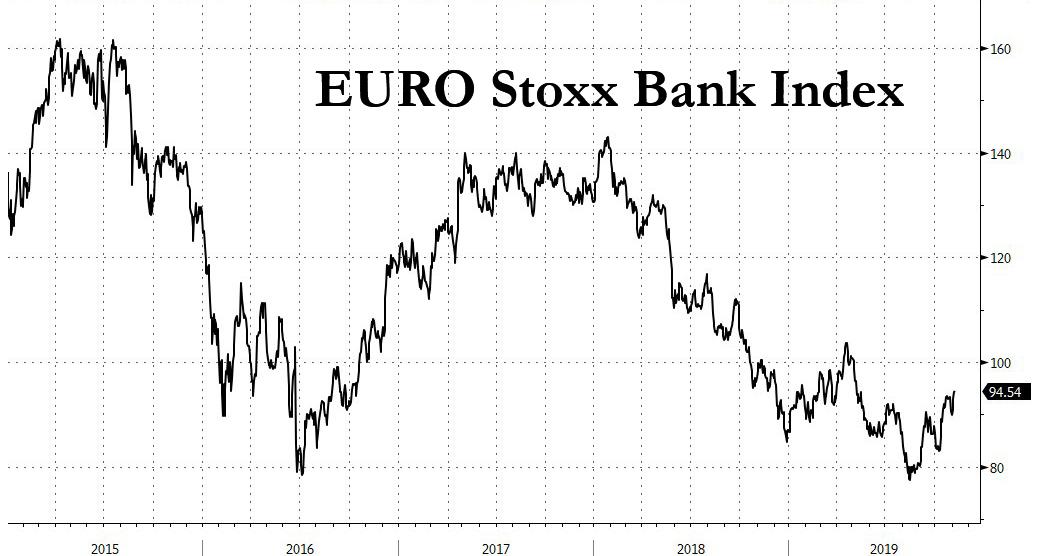
Bottom line: European banks are the Lake Victoria of the current rally in globalfinancials and therefore also the source waters for the ongoing lift in value stocks.
Exhibit #2: German 30-year sovereign bonds:
Since the German government runs a balanced budget, long-termbunds are in perennial short supply relative to US Treasuries.
Along with that, the long duration of German 30-years makes this asset singularly twitchy to market sentiment about Eurozone economic growth.
At the end of August, when US-China trade talks were at their nadir, the market for 30-yearbunds was signaling the real risk of a deep European recession. Yields got as low as -0.27%.
Now, the yield on 30-yearbunds is positive again to the tune of 0.16%. Ok, not great but also not (quite) staring into the abyss. Treasuries have followed along, assuaging concerns created by a previously inverted yield curve.
Here is a 5-year yield chart for this paper:
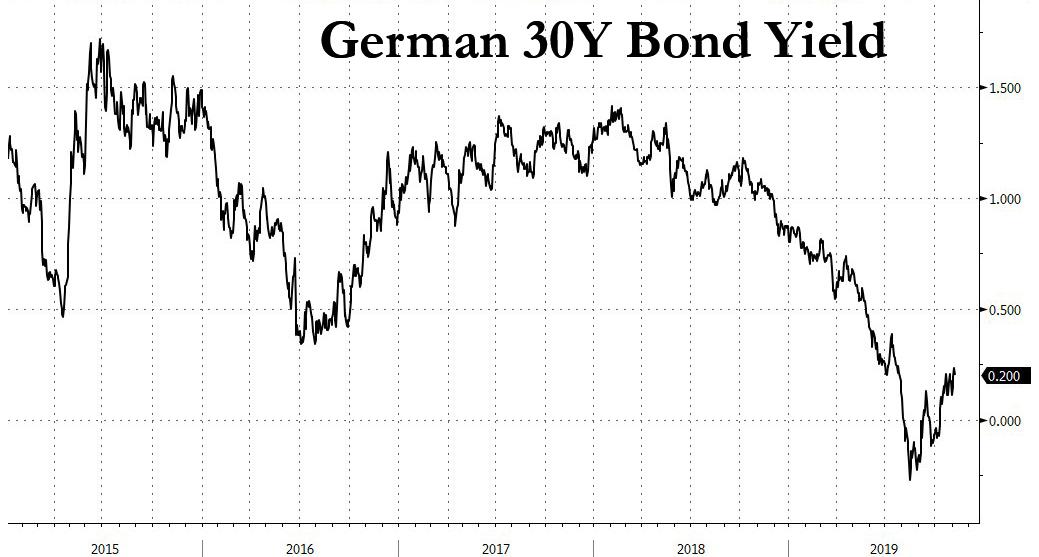
Bottom line: the lift in long-term German yields since late August was the spark that reignited the global market’s animal spirits in September and October. Europe may be teetering on the edge of recession, but lessening US-China trade tensions may save it from falling into too deep a hole.
Exhibit #3: The offshore yuan/dollar exchange rate:
When the offshore yuan blew through the old “line in the sand” level of 7/$ in early August, you knewmarkets were worried US-China trade talks were sputtering.
These reached their peak in early September, at 7.19/$.
Since then, the yuan has crawled its way back to (almost) 7.0, closing today at 7.03.
Here is a 1-year chart for the offshore yuan:
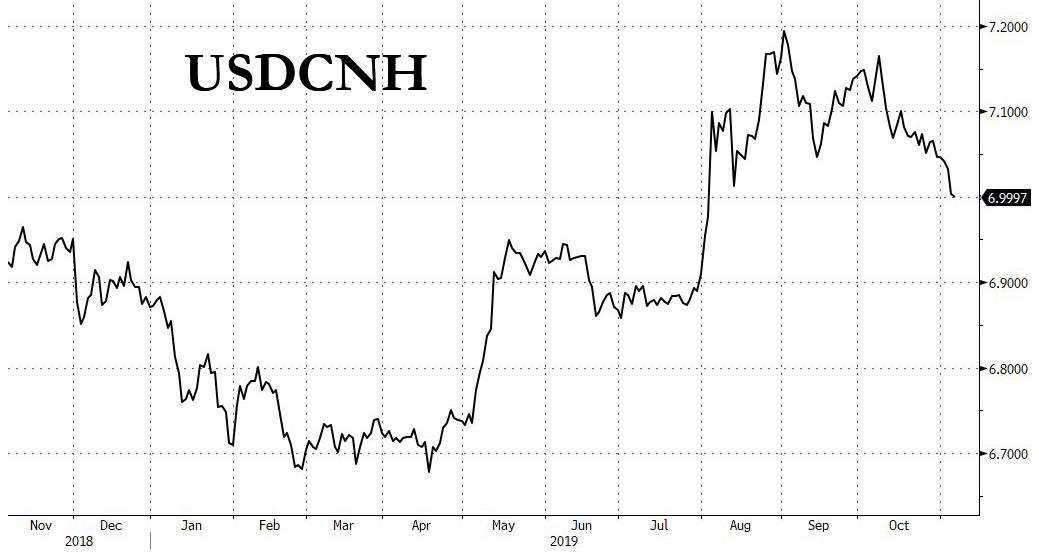
Bottom line: even if US-China trade talks seem unpredictable, yuan traders are expressing confidence that they remain on the right track. That feeds into global capital markets’ bullish tone just now.
In summary, these are the 3 butterflies of the current global equity rally, each flapping their wings on distantshores but in aggregate creating something productive rather than “chaos”. A look at the chart for each shows they all have room to run. As such, they are the 3 indicators we’ll be watching most closely. For now, however, this is one example of Chaos Theory that is working in investors’ favor.
Chaos Theory gets a bum wrap, and I think the reason is bad branding. The most common explanation of the phenomenon is the classic “a butterfly flapping its wings in Thailand can cause a hurricane in the Gulf of Mexico”. Initial conditions, in other words, can have outsized effects in complex systems like weather patterns. Fair enough, but one usually associates Chaos Theory with bad outcomes like cyclones and stock market crashes.
What about when initial conditions push their way through to create unexpectedly good outcomes? That’s
Turning to the current sunny spell in global risk markets, three examples of why Chaos Theory can work
Exhibit #1: European Bank Stocks:
In early August, the EURO STOXX Banks Index looked like it was about to implode. At 77, it had not been lower since the 1990s. We wrote about it, highlighting that several market bears thought the group was destined to go into
But then the group found its footing as Eurozone long-term interest rates bottomed (more on that in a minute).
From August 15th to now, the index is up 20%. Disaster averted, at least for now.
The group’s move has lit a fire under global bank stocks. US large cap Financials are up 12% since mid August. Small caps are +8% and Japanese banks are +14%.
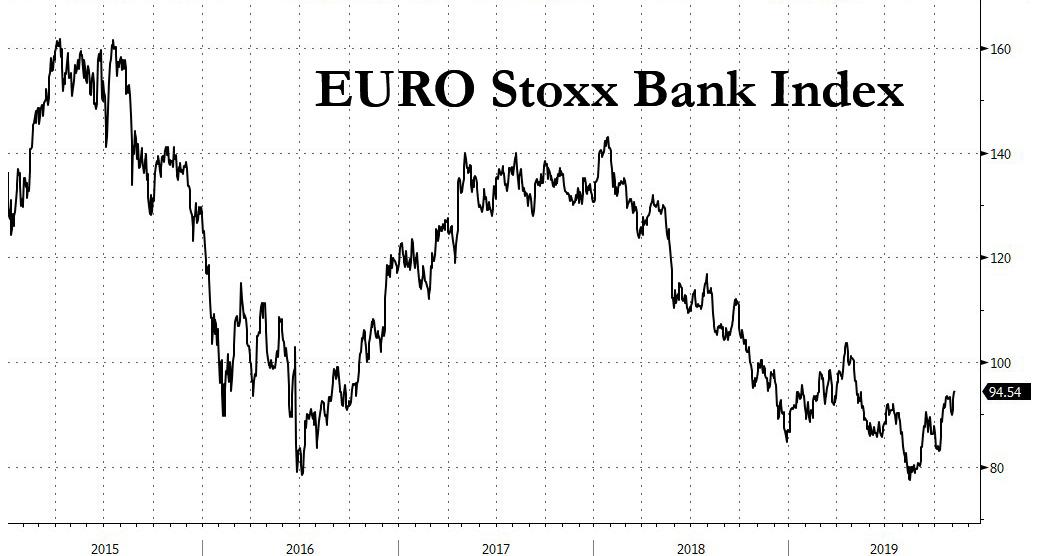
Here is a 5-year chart of the index to give you some historical perspective:
Bottom line: European banks are the Lake Victoria of the current rally in global
Exhibit #2: German 30-year sovereign bonds:
Since the German government runs a balanced budget, long-term
Along with that, the long duration of German 30-years makes this asset singularly twitchy to market sentiment about Eurozone economic growth.
At the end of August, when US-China trade talks were at their nadir, the market for 30-year
Now, the yield on 30-year
Here is a 5-year yield chart for this paper:
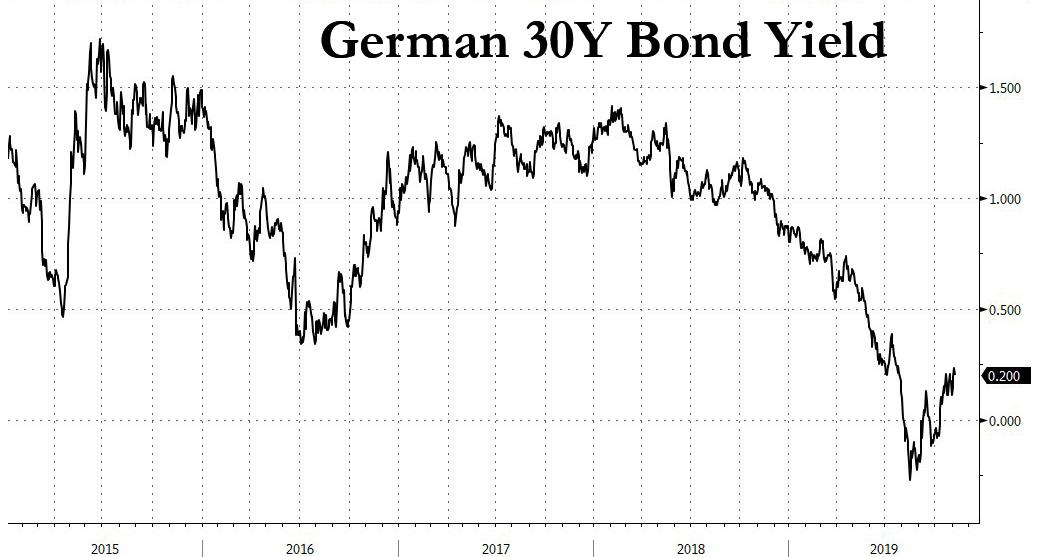
Bottom line: the lift in long-term German yields since late August was the spark that reignited the global market’s animal spirits in September and October. Europe may be teetering on the edge of recession, but lessening US-China trade tensions may save it from falling into too deep a hole.
Exhibit #3: The offshore yuan/dollar exchange rate:
When the offshore yuan blew through the old “line in the sand” level of 7/$ in early August, you knew
These reached their peak in early September, at 7.19/$.
Since then, the yuan has crawled its way back to (almost) 7.0, closing today at 7.03.
Here is a 1-year chart for the offshore yuan:
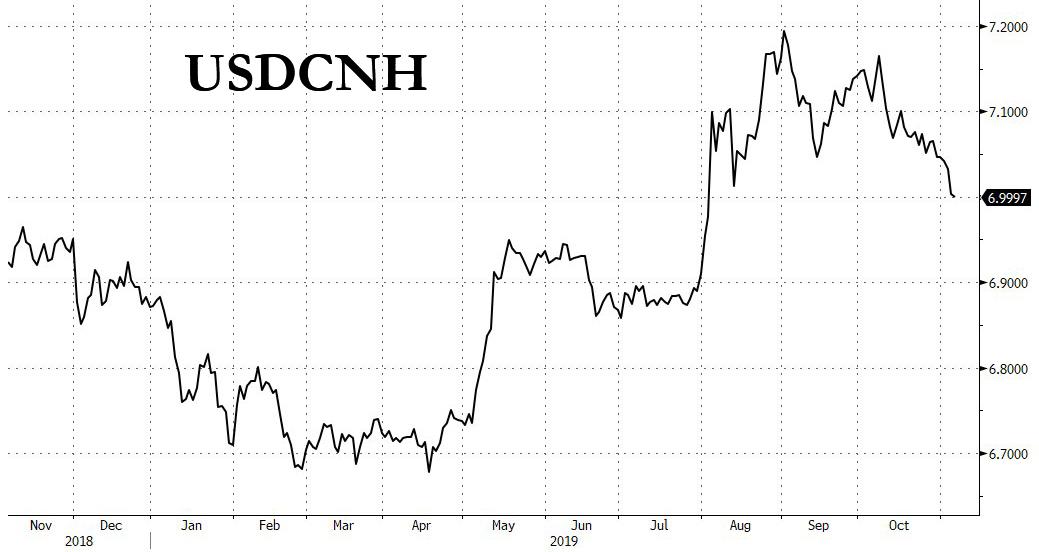
Bottom line: even if US-China trade talks seem unpredictable, yuan traders are expressing confidence that they remain on the right track. That feeds into global capital markets’ bullish tone just now.
In summary, these are the 3 butterflies of the current global equity rally, each flapping their wings on distant
- Source, Zero Hedge
Tuesday, 5 November 2019
Max Keiser: China secretly hoarding gold and will unleash crypto backed by metal and destroy USD
I can tell you that the cryptocurrency that China’s rolling out will be backed by gold. It’s a two-pronged announcement. Number one, China’s got 20,000 tonnes of gold, number two, we’re rolling out a crypto coin backed by gold, and the dollar is toast,” Keiser told Kitco News.
- Source, Kitco News
Sunday, 3 November 2019
Wealth Accumulation Is Becoming Impossible
We talk a lot about the falling interest rate, the too-low interest rate, the near-zero interest rate, the zero interest rate, and the negative interest rate. Hat Tip to Switzerland, where Credit Suisse is now going to pay depositors -0.85%. That is, if you lend your francs to this bank, they take some of them every year. Almost 1% of them.
A bank deposit comes with a risk. But instead of compensating you for the risk, the bank pays you nothing. So it’s a return-free risk. And worse than that, a negative rate means that you are paying the bank in order to take the risk of lending to them.
Jabberwocky
Lewis Caroll wrote some pretty crazy stories, but even he did not think of something so absurd as this. A vorpal blade that went snicker-snack on the Jabberwock is nothing, compared to a bank that goes snicker-snack on your deposits! Hmm, maybe there is a good analogy here.
A fantasy role-playing game called Dungeons & Dragons has a magic sword called a vorpal sword that is extra likely to cut off your opponent’s head. And a fantasy economics called Keynes & Monestars has a planner called a central bank that is likely to cut off civilization’s head. But we digress.
Someone might retort “well, don’t put your money in a bank! Put it in the stock market.”
Money in the Stock Market
Of course, a bank depositor does not have money (or irredeemable currency, as today) in a bank. He has lent it to the bank. We believe that it’s important to understand these things at a mechanical level.
More to the point, a stockholder does not have money in the stock market. He paid his money to the prior owner of the stock. That person got the money, and may well have spent it. Perhaps on a Vegas binge. Maybe the bartender who unbottled the booze on his bender bought shares…
But as far as the new stockholder is concerned, his money is long gone. He traded it for stock. Why did he do that? Because he expects that someone else will pay him even more money in the future. Why would someone pay him more? Because that guy expects the next guy to pay even more than that. And so on.
As an aside, this would be all good if the shares went up because the company’s earnings went up. In that case, investors should be happy to pay double—because they’re getting double the earnings. Because they would be getting twice the dividend (or more). However, this does not describe our world. We live in a world of falling interest rates.
As interest the rate falls, people pay more for the same dollar of earnings.
Consider a simple case. Suppose Prudence Inverness bought a share of the Dollar Corporation. She paid $10 for it. TDC earns—you guessed it—one dollar per share. This means the earnings yield on her investment is 10%. The CEO, Dave Dahle, sets the dividend at $0.20, so her dividend yield is 2%.
A year passes and TDC earns —still—one dollar per share. Is Prudence any richer?
Next, Spencer Speccalatore else comes along. He bids $20 on the same share in TDC, with the $1 of earnings and $0.20 of dividend . Now is Prudence any richer now?
If she takes Spencer’s $20, then obviously she is $10 richer. However, Spencer is not. Assuming her purchase of the TDC share for $10 was fair value, then Spencer becomes poorer by paying double for the same share that earns the same dollar.
At any rate, Spencer does this because he expects Willie Wild to buy it from him for $40. And Mr. Wild pays $40 because he expects Mark Madenes to pay $80, and so on.
Obviously, there comes a point at which no further buyer is willing to pay more. Then the price crashes. That is when most people would say that the wealth was lost. This article in the Atlantic captures this idea:
“Between February 2000 and February 2002, the NASDAQ lost three-quarters of its value… By late 2000, more than $5 trillion in wealth had been wiped out.”
Conversion of Wealth to Income
We’ve written many times before, that the wealth of the Spencers, Willies, and Marks is converted into the income of the Prudences, the Spencers, and Willies (yes, some of those who converted their wealth into someone else’s income, later receive yet another person’s wealth as their own income).
When wealth is converted to income, much of that income is spent. That is the moment when it is wiped out. The price collapse occurs later. That’s just the accounting catching up to the reality.
This was a bit of a digression, but important enough to be worth the words necessary to describe this process. However, our main focus today is at a different angle.
Where, in this process of bidding up the same share of TDC with the same dollar of earnings and the same twenty cents of dividend, is wealth being accumulated? We mean this from an economy-wide perspective, not merely looking at Prudence, Mark and Willing. They are the lucky ones who bought lower and sold higher. And, in the end, their cumulative gains were matched by the loss of one Mr. Wild.
All during the process of bidding up the shares, wealth is not being accumulated. It is being dissipated. Each selling shareholder has a gain , and spends some of that gain (even if he would not, the tax man takes some of it).
Interest Matters
We write a lot about the need for interest. This is not merely some lament for the poor wage-earner, who many presume to be too dumb and too unsophisticated to invest properly (i.e. buy shares of TDC at ever-higher prices), and who is therefore relegated to the sad fate of depositing his savings in a bank.
Although of course there are many people who don’t buy shares. And they do deserve some sympathy because they are being given a raw deal.
Our point is much broader than this one group. Those who are smart and sophisticated enough to buy shares of TDC, think to use shares as a surrogate for savings. Rising share price is a substitute for interest. And—unless they are Mark Madenes—it may seem to work for them.
However, there is a key difference. Savings is used to finance an increase of production, a profitable business. The interest is paid out of that increase. Rising share price finances nothing of course, and the capital gain of each selling shareholder comes from the next buyer’s capital.
No wealth is accumulated in this process of bidding up asset prices. In fact, it is being de-cumulated.
The Fed and other central banks have waged a War on Interest. They are now victorious. It’s all over, but the mopping up. Positive interest is not coming back to the franc; zero interest will come to the dollar soon enough.
This is why Monetary Metals is obsessed with paying interest on gold.
Supply and Demand
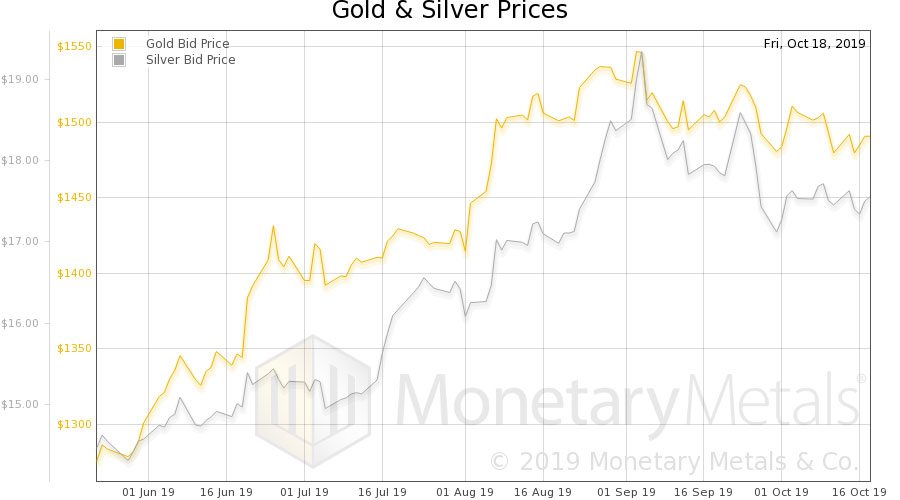
The prices of the metals barely budged this week.
It is interesting to note that this week, more than one central banker felt it necessary to say something about a possible next crisis. And at least one of them said something about gold. We do not place much stock in what these guys say for obvious reasons. Like Elmer Fudd armed with a gun that couldn’t quite hit any target, the central bankers are armed with a theory that couldn’t quite explain an economy.
However, there are certain things they can see—sometimes ahead of most others. One is the stress on the banks. The Swiss Bankers Association says that negative rates are costing them $2 billion a year. Two billion here, two billion there, and pretty soon it adds up.
The banks want an end to negative rates, but as we have written at great length, this is impossible. So right now, they are facing a drain of their capital of two billion a year. The banks are trying to catch up by charging their clients even negativer rates.
This could cause a run on the banks, if depositors withdraw paper bank notes (which have an interest rate of zero). Just like in our discussion of the repo market intervention, each policy imposed by the central banks has consequences that make them impose the next policy. We said:
“An image that comes to mind is a mad ocean monster, like akraken . It is blasting a sea dike with many high-pressure hoses. This causes leaks, but thekraken keeps plugging them with more and more tentacles.”
We eagerly await (not really, just a figture of speech) the next policy response of the Swiss National Bank, and the other central banks. Especially if these rumblings of the next crisis are real. As students of the gold basis, we expect to see an early warning.
Read on for a look at that early warning system. But, first, here is the chart of the prices of gold and silver.
(Click on images to enlarge)
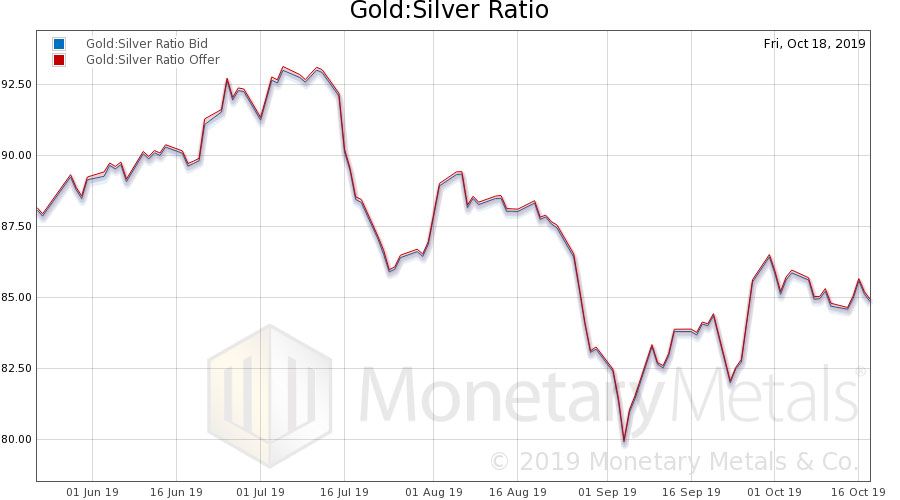
Next, this is a graph of the gold price measured in silver, otherwise known as the gold to silver ratio (see here for an explanation of bid and offer prices for the ratio).
Here is the gold graph showing gold basis, cobasis and the price of the dollar in terms of gold price .
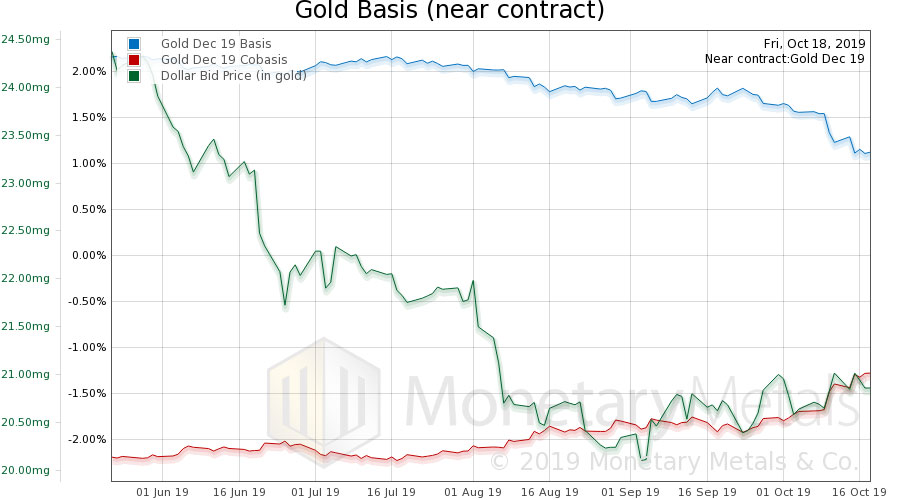
The cobasis increased again, with no drop in price. Gold is just that smidge scarcer that it was. Though we must emphasize this is far from the level we would expect in a crisis.
The Monetary Metals Gold Fundamental Price, was up another $19 this week, to $1,483.
Now let’s look at silver.
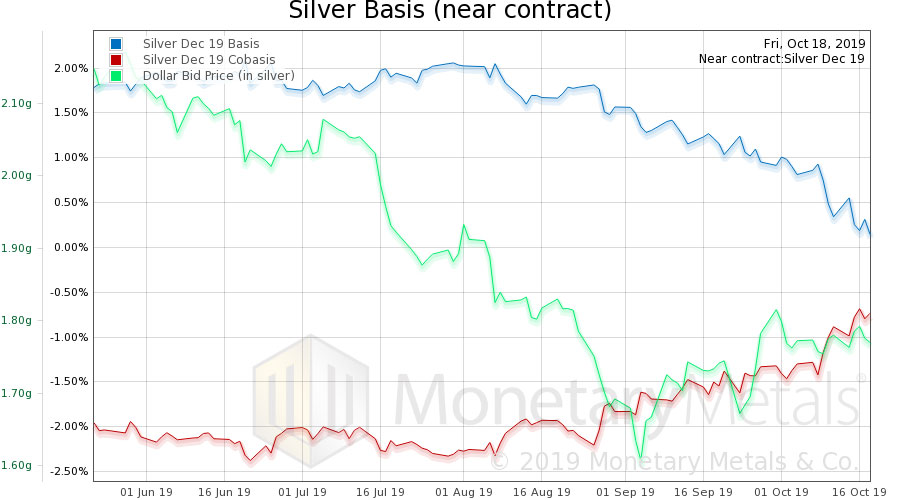
In silver, the same thing happened to the (December) cobasis , though not the silver basis continuous.
- Source, Keith Weiner via 321gold
Friday, 1 November 2019
There’s No Silver Shortage…For Now
Now the market is taking a breather, but we could well see the traditional Q4 rally could take prices much higher.
There have been persistent rumors about a coming silver shortage, but David is unconvinced. But that doesn't mean there's not one looming, especially if investment demand picks up.
- Source, Financial Survival Network
Subscribe to:
Posts (Atom)