buy gold and silver bullion

Tuesday, 30 April 2019

Perth Mint Gold and Silver Bullion Sales Surge in March

Australian gold and silver bullion sales advanced sharply in March from February but they declined in the first quarter 2019 compared to the same period in 2018, according to figures from The Perth Mint of Australia.

The Mint’s gold sales in March was the highest in four months after logging an eight-month low in February and demand for its silver coins and bars climbed to a five-month high after sliding to a six-month low.

March increases happened against a backdrop of plunging precious metals with LBMA prices registering losses of 1.8% for gold and 4.5% for silver.

Bullion Sales in March 2019

March sales of the Mint’s gold coins and gold bars reached 32,757 ounces, posting gains of 67.8% from February and 9.6% from March 2018.

First quarter gold sales at 83,470 ounces dropped 10.8% from the 93,530 ounces sold in the first three months of 2018.

Perth Mint sales of silver coins and silver bars reached 935,819 ounces last month, jumping 60.2% from February but dipping 4.1% from a year ago March.

The Mint’s first quarter silver sales at 2,348,983 ounces fell 22.6% from the 3,036,236 ounces sold during the same period in 2018.

Perth Mint Gold and Silver Sales by Month

Below is a monthly summary of Perth Mint bullion sales from March 2018 to March 2019. The figures show monthly ounces of gold and silver shipped as minted products by The Perth Mint to wholesale and retail customers worldwide. 

It excludes sales of cast bars and other Group activities including sales of allocated/unallocated precious metal for storage by the Depository.


- Source, Coin News

Monday, 29 April 2019

Why The United States Needs To Encourage Americans To Hold Gold


Foreign central banks are acquiring gold at the fastest pace in 50 years, and their purchases are not driven by investment considerations alone. The Central Bank of Russia, 2018’s largest official sector buyer of gold, wants to reduce Russia’s dependence on the dollar, while the Hungarian National Bank noted gold’s increasing strategic importance as underlying their recent purchases.

America cannot stop foreign central banks from buying gold or reintroducing gold into the international monetary order. We can, however, adopt policies that will attract more of the world’s gold to the United States and position ourselves to deal with the remonetization of gold from a position of strength.

At the end of the Second World War, the U.S. Treasury owned more than 30 percent of the world’s gold. Today, that same figure is less than 5 percent. America’s diminished share of the world’s gold is a result of our defense of the Bretton Woods System prior to its collapse in 1971 and subsequent failure to increase our gold reserves. The U.S. Treasury has not added to its gold reserves since 1969, and the Federal Reserve has not owned physical gold since the passage of the Gold Reserve Act in 1934.

American investors have also been largely absent from the physical gold market in recent years. In 2018, Americans purchased just 28 tonnes of gold coin and bars, less than 1 percent of global mine production. Americans’ lack of investment appetite for physical gold reflects more than our collective faith in the dollar. It also reflects American tax policy that subjects physical gold, even gold coined by the U.S. Mint, to a higher tax rate than many other investments, including some gold derivatives.
A Global Gold Rush

While discouraging and even prohibiting Americans from owning gold was never good policy, it was at least understandable at a time the Federal Reserve was struggling to maintain parity between the dollar and a fixed weight of gold. But continuing this policy is deeply misguided at a time the dollar bears no fixed relation to gold and other nations, most notably China, are encouraging their citizens to accumulate gold.

For the better part of two decades, the Chinese government has been removing impediments to Chinese gold investment. The opening of the Shanghai Gold Exchange in 2002, which brought liquidity and transparency to the Chinese gold market, ushered in a series of Chinese pro-gold policies. Restrictions on private gold ownership were lifted, domestic gold mining was encouraged, and the value-added tax on gold purchases was repealed. As a result, China has become both the largest miner and importer of gold in the world.

While China has thoughtfully adopted a series of policies to increase its domestic gold holdings over time, other countries have taken the more direct approach of central bank purchases. In 2018, central banks added 652 tonnes of gold to their reserves, with the Russian Central Bank accounting for 274 tonnes of that total.

Not only are central banks buying gold at the fastest pace in 50 years, but central banks are repatriating gold they have long held abroad. In recent years, Germany, Turkey, and the Netherlands have brought their central banks’ gold home. This decision to repatriate the physical metal recognizes that some of gold’s unique attributes are undermined if the metal is held abroad or in derivative form.
America Must Go for Gold

America’s longstanding gold policy is at odds with these global trends. While the U.S. Treasury holds its gold domestically, current U.S. regulatory and tax policy facilitates the acquisition of gold held both in its paper form and abroad. SEC-registered Gold Exchange-Traded Funds (ETFs), the most popular way for Americans to buy gold in recent years, hold a majority of their gold abroad. The federal government taxes gold futures and related gold derivatives at a lower rate than physical gold, a policy that provides exactly the wrong incentives for America’s investors.

A far more sensible policy would encourage the purchase of physical gold held here at home. The U.S. Treasury can take an important step in this direction by recognizing that the gold coined by U.S. Mint is money, not property, and unilaterally remove the collectables tax that currently applies to U.S. minted gold coins.

This decision, which would cost the federal government a negligible amount of tax revenue, would end the logically inconsistent practice of taxing Americans for converting one form of legal tender to another. But, more importantly, this change in IRS interpretation would signal that the federal government welcomes the domestic accumulation of U.S. minted gold.

With a growing number of countries encouraging their central banks and citizens to acquire gold, it is increasingly reasonable to assume that gold will be part of the world’s monetary future, not just its past. The U.S. Treasury should embrace policies that will attract more of the world’s gold to America and better position our citizens and our nation for whatever the monetary future may hold.

- Source, The Federalist

Saturday, 27 April 2019

The Fall of Wells Fargo: The Collapse of the Banking Sector


Josh Sigurdson talks with author and economic analyst John Sneisen about the inevitable collapse of the banking system as they continue to get more and more desperate to prop up their pyramid while scandals are revealed on a regular basis. 

Wells Fargo is one bank that has had so many scandals in the past few years that it's truly incredulous that they're still operating. From millions of fake accounts, repossessing people's cars and homes with fake mortgages and fake insurance, the list goes on. 

Recently in Dallas, many people found their way into a Wells Fargo meeting to tell the interim boss C. Allen Parker what they thought of him and the bank itself. It was not pretty. 

The public is waking up to the banking system and the banking system cannot escape its past. It's not just Wells Fargo. Deutsche Bank and Commerzbank merging is another example of the desperation of the banking system as their entire complex collapses at the foundation. 

The banks are bankrupt. Their balance sheets show their cash to deposit ratio at dramatically low levels. The currency they're printing, indebting the populace is being met with opposition by the populace after years of destroying the middle class and creating a perpetual paradigm of debt and dependence. 

The banks are desperately attempting to create their centrally planned cashless society with governments world wide. They think it will stop bank runs and avoid the inevitable a little bit longer, but people are breaking free from that system. 

The banks are the old guard. People are utilizing cryptocurrencies and blockchain infrastructure technology. They are educating themselves. They are protecting their purchasing power. 

They are stacking gold and silver. They are doing what they should. At least, enough of them to disrupt the entire banking system anyways...


Friday, 26 April 2019

Gold: You Either Understand it or You Don't


The gold spot price is closing today around the $1,280 US dollar price per troy ounce level, while the silver spot price stayed flat closing this week again around the psychologically important $15 per troy ounce full fiat Federal Reserve note price. 

With us this week a new guest to the show, and one of the most eloquent market commentators on the precious metals markets. 

He is a co-founder of Real Vision financial media website, also the noted author of the popular TTMYGHmmm newsletter, and a more than three-decades-long veteran of the global financial markets. 

Mr. Grant Williams is here to speak to us about gold, his company's founding, as well as the difficulty that global central banks and governments now find themselves enveloped in.

- Source, Silver Doctors

Wednesday, 24 April 2019

Credit Suisse Explains How Angry Societies Have Changed the World


The problem of “angry societies” has shifted the global political landscape in ways that were unthinkable in the past, according to Credit Suisse.

Among those changes are a nationalistic shift in government policies and the U.S. withdrawal from multilateral agreements that it once led, said Lito Camacho, vice chairman at Credit Suisse Asia Pacific, on Tuesday.

“This theme of angry societies has been a brewing problem created by many different factors: The gap between the rich and the poor in many countries, you’ve got issues surrounding immigration and so on,” he told CNBC’s Martin Soong at the Credit Suisse Global Supertrends Conference in Singapore.

“And it’s creating angry people that’s changing the political landscape around the world,” he added. “It’s really a new world we’re faced with.”

Other experts had said that the rise of populism in recent years was a contributing factor behind the election of U.S. President Donald Trump and the U.K.’s vote to leave the European Union. Such developments came at a time when China marked the start of its rise as a global superpower — a trend that many western economies are learning to cope with, Camacho pointed out.

Countries in the west dominated the world economy for much of the last 200 years, he said. But China, by some measure, has become and will remain the largest contributor to global growth, according to forecast by the International Monetary Fund.

- Source, CNBC

Tuesday, 23 April 2019

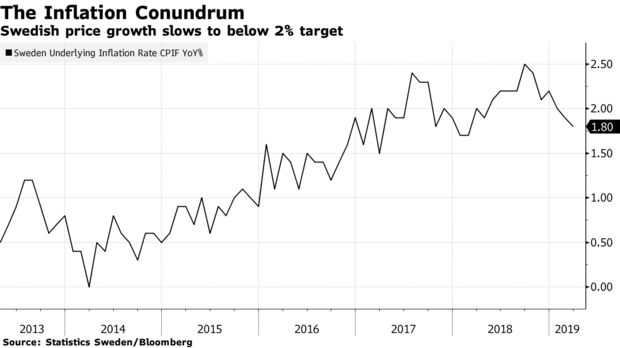
Inflation Slowdown Is Again Stalking Sweden's Central Bank

Central banks across the world are grappling with the mystery of how to bring back inflation and there are few places where the struggle has been as profound as in Sweden.

This week, policy makers in Stockholm are meeting as price growth has slipped far below their estimates and their 2 percent target. Just a few months ago, they raised rates for the first time in seven years, plotting a path out of negative rates this year amid growing confidence they had managed to restore credibility in their inflation regime.

But on Thursday they will likely be forced to again lower their rate outlook, potentially pushing back an increase signaled for September and prolonging an era of negative rates. Led by Governor Stefan Ingves, the bank is also expected to extend its bond purchases (by pre-reinvesting bond maturities) beyond June, while keeping the benchmark at minus 0.25 percent.


Inflation pressure has “definitely been lower than the Riksbank counted on” said Torbjorn Isaksson, chief analyst at Nordea Bank Abp. “There are fewer and fewer economic arguments for the Riksbank to raise rates.”

As global and European growth loses momentum, Sweden’s economy is cooling and unemployment is forecast to rise. A global reassessment of monetary policy, led by the Federal Reserve halting its hiking cycle, is weighing on the Riksbank’s plans to tighten. The European Central Bank is planning more stimulus as it expects its key rate to be unchanged at least through 2019.

Nevertheless, policy makers in Sweden have a lot invested in their exit out of so many years of negative rates and they surprised markets in February by sticking to their plans. The krona has tumbled this year, giving the Riksbank more room to raise rates. Some on the board, including Deputy Governors Cecilia Skingsley and Martin Floden, have also flagged that they are willing to live with inflation that holds just below the target, as long as expectations stay anchored around 2 percent.

According to SEB AB, the main scenario is that the rate path will indicate a slightly later hike but that the Riksbank will maintain that an increase will come “during the second half of the year.”

But unemployment surprised negatively in March and the number of jobless seems to have bottomed, according to Svenska Handelsbanken AB’s Chief Economist Christina Nyman.

“Unless there’s considerable inflation pressure, it’s going to be a challenge if you are at about to raise rates and you at the same time have rising unemployment numbers,” she said.

- Source, Bloomberg

Sunday, 21 April 2019

Why Gold Could Rise For The Next 10 Years...

Contrary to popular opinion, gold and silver are not hedges against a crisis. In fact, a crisis may cause all salable assets, including precious metals, to be sold in order to get cash.

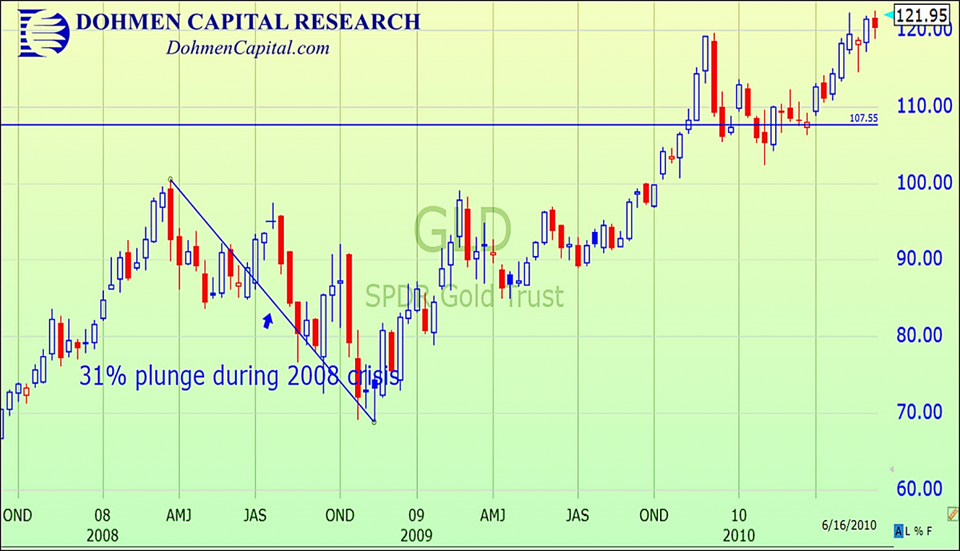
At Dohmen Capital Research, we believe a good recent example is the 2008 global crisis. Gold plunged 31% as credit tightened, the crisis accelerated and a rush to cash from all assets commenced. That was painful for bulls who didn’t know that a credit crisis causes all assets to plunge. But it also created a great buying opportunity at the bottom. Here is the chart of the gold ETF during that time:


DOHMEN CAPITAL RESEARCH

Gold investors must realize this to protect themselves in times of crisis. Cash in the form of a stable currency is the most desirable asset to hold during such times.

However, crises cause the central banks to step on the monetary accelerator, which then makes gold a great investment as you can see on the chart above. That bull market in gold went from late 2008 to late 2011, three years. As our motto says, “timing is everything.”

Gold has been widely ignored since 2011 as an asset class for institutional portfolios. However, that should change as most other asset classes deteriorate and become unattractive for a while.

What is bullish for gold? My opinion is that gold is primarily an inflation hedge, actual inflation or the perception of future inflation, as currencies are debased by governments that can’t pay their bills.

With long-term bullish sentiment on the precious metals so low until late 2018, and the gold price in terms of many foreign currencies already near or at new record highs, it’s only a matter of time before the U.S. dollar price of gold shoots upward. Although the very short term may see more of a pullback, the long-term factors are very constructive.

Gold’s Bullish Prospects For The Longer Term

In 2018, bullish sentiment for gold and silver was at a multi-year low. Very few people were interested. That’s usually the time to take a fresh look, technical and fundamental. If everything lines up, my analysis would go against the bearish majority.

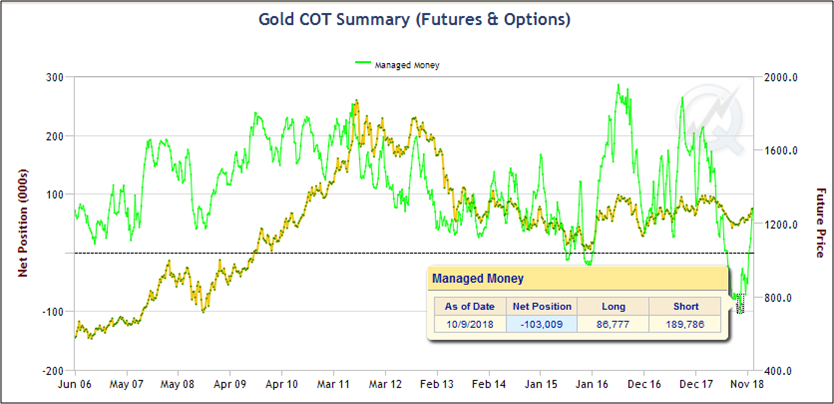
The chart below shows the exposure to gold of managed money in gold futures and options (green line). It shows that the allocation to gold was at its lowest point on this chart in October 2018, at least since 2006. Also important is that in spite the extremely low interest in gold, the gold price (yellow line) in 2018 was higher than at the gold low in 2016.

I call this a very important long-term, bullish divergence.


CME GROUP, CFTC

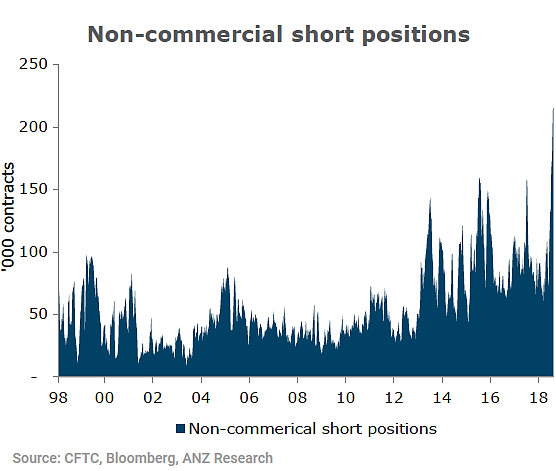
Looking even longer term--20 years--the chart below shows the “non-commercial” short positions. These are the speculators who are usually wrong at the important turns.

The fact that speculators, i.e. non-commercials, had record short positions in 2018 confirms that a lot of short covering may occur, to be followed by actual buying. That would mean greater demand.


CFTC

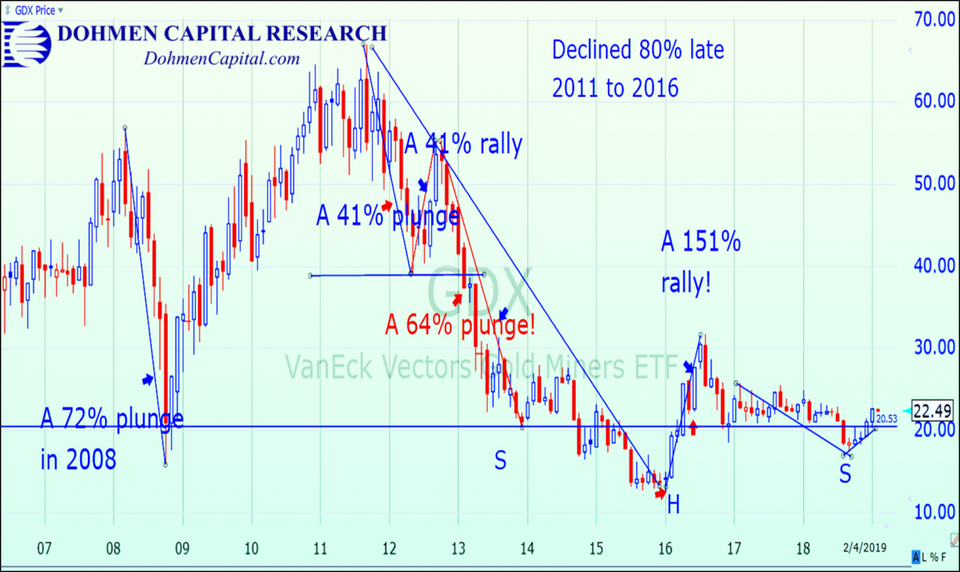
The bottom in the precious metals has been forming since early 2016. As you can see from the chart below of the ETF for the gold miners, VanEck Vectors Gold Miners (GDX), it had a quick rally that year and then went into another sideways pattern until January 2019. Now the chart appears to be getting ready for a stronger up-move

You can see that a long, bullish potential inverse “head and shoulder” pattern has formed. If a breakout occurs, it would mean that the early 2016 low was a false downside breakout on a major (longer-term) scale. Such breakouts usually have very strong moves in the opposite direction, in this case upward.

DOHMEN CAPITAL RESEARCH

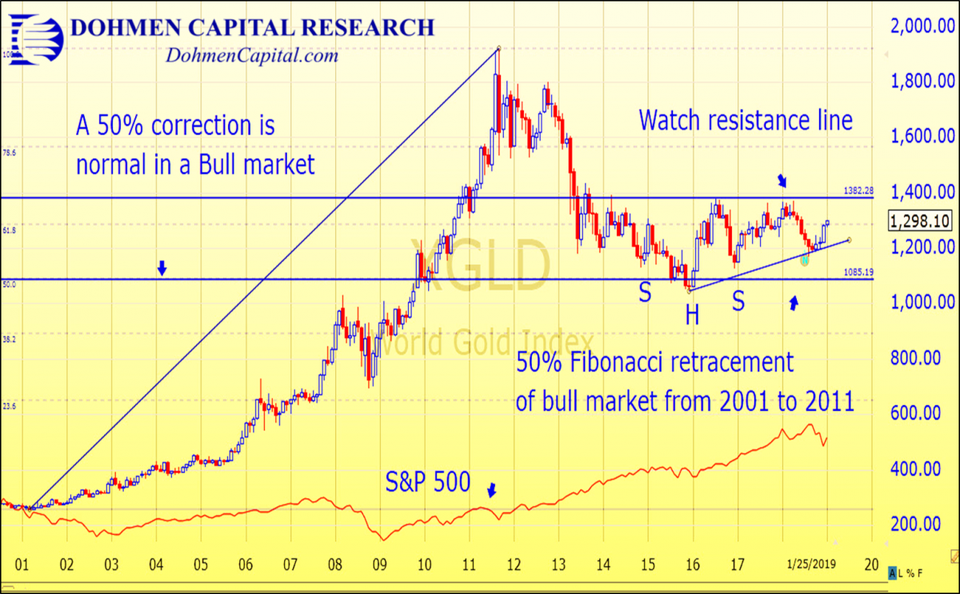
The chart below of the gold bullion price (monthly) is bullish. The bottom of the “cup” has been forming since early 2016.

Look at the long-term view of gold bullion since the year 2000. It had a huge rise from around $250 to more than $1,930 in 2011. That was followed by a substantial 50% correction starting in 2012. A 50% correction in a major bull market is not unusual.


DOHMEN CAPITAL RESEARCH

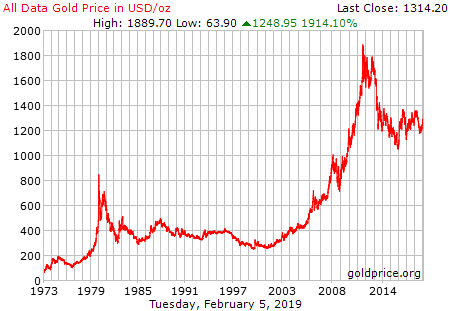
Long-time Wellington Letter clients will remember the gold market peak in late 1980. The price of gold had soared above $800 in 1980. Many analysts were forecasting a rise to $3,000. I predicted a 20-year bear market in gold in the Wellington Letter in 1981 based on my cycle analysis. That was greeted with universal disbelief. But it happened.

As we now know, the bear market lasted until 2001, exactly 20 years, just as we had forecast in 1981. Usually, cycles are not that precise (see the chart below).


GOLDPRICE.ORG

Just as important: The second part of our forecast in 1981 said that according to our very long-term cycle study, that bear market would be followed by a 30-year rise in gold. We even said we had no idea what would cause it, but the cycles said it should happen.

If the forecast I made in 1981 still holds true, gold could have a continued secular bull market until 2030 . That means the gold bull market could have about 11 more years to go. Historically, the final phase of a bull market is the most spectacular.

Of course, cycles can shift to the right or the left, but the bear market cycle was right on target.

Friday, 19 April 2019

Entire System Based on Debt with Historic Liability


Financial writer and precious metals expert Bill Holter contends, “The entire system is based on debt. 

The entire system is a liability. So, some people are getting some of their money out of the system into real money (gold and silver) which is no one else’s liability.

The biggest thing is there is too much debt in the system. Everybody owes everybody, and all you need is one link in the chain to break. All you need is one entity that cannot make good on what they promised.”

- Source, USA Watchdog

Wednesday, 17 April 2019

Tuesday, 16 April 2019

Russia & China Abandon USD as Trade War Erupts at Top of Credit Cycle


Are you being told there's a perfect storm converging on our financial lives from all sides? 

Jus​t at the credit cycle is peaking, the real economy from housing to retail and beyond is creaking and straining, the stock market is starting to roll over, President Trump and the Chinese are escalating a full-on trade war. 

Add to this that China and Russia are pivoting at record speed away from the USD, dumping US treasuries, creating non-Dollar trade, and most ominously - hoarding gold as never before in history - all in preparation for what is coming. 

Alasdair Macleod, head of research at GoldMoney.com, returns to Reluctant Preppers to report on the international economic trends and to ask, "What will you do if you wake up one morning and your the US Dollar isn't worth anything?" 

Join us for this mind-opening examination of what comes next!


Saturday, 13 April 2019

Alasdair Macleod: Preparing for Gold as Currencies Crumble


Alasdair Macleod explains why the only portfolio protection from these potential demise of fiat currencies is to embrace sound money, gold.

- Source, Jay Taylor Media

Friday, 12 April 2019

Assange Arrested, Deep State, Dems and MSM Panic, Gold Shining


Julian Assange, the founder of Wikileaks has been arrested.

Join Greg Hunter from USA Watchdog as he looks at these stories and more in the Weekly News Wrap-Up.

- Source, USA Watchdog