buy gold and silver bullion

Tuesday, 26 November 2019

Ray Dalio and central banks turn to gold, prepare for crisis


While the Federal Reserve seems to hold a neutral view of the economy in the medium-term, prominent investors like Ray Dalio, as well as central banks, are stockpiling safe haven and hedge assets to prepare for what they believe is a coming economic downturn, this according to Phil Streible, senior market strategist of RJO Futures. 

“One of the guys who I really follow, Ray Dalio and Bridgewater, they came out and bought about a billion dollars worth of put options in the S&P 500, so that tells you that these guys are preparing for some kind of crisis,” Streible told Kitco News. 

- Source, Kitco News

Monday, 25 November 2019

The Vigilante's View on Gold, Crypto, Manipulation, Health and Wealth


The Vigilante's View on Gold, Crypto, Manipulation, Health and Wealth, Jeff Berwick on Crush the Street.

Saturday, 23 November 2019

Serbia’s gold buying may mean a lot more than you think


Serbia has just joined the ranks of other European central banks and bought nine tonnes of gold, and this could signal a looming economic crisis that the banks are preparing for, said Rory Hall, publisher of The Daily Coin.

- Source, Kitco News

Friday, 22 November 2019

Robert Moriarty: Has Novo Resources Made the Gold Discovery of the Century?


Robert Moriarty, who has visited Novo’s gold project, shares his ideas about its prospects as well as some other gold exploration projects he is bullish on.

- Source, Jay Taylor Media

Thursday, 21 November 2019

Here’s the secret to owning perfect amount of gold


The amount of gold to hold in a portfolio that optimizes an investor’s risk/return profile is much higher than what most would hold, this according to Ryan Giannotto, director of research at GraniteShares. 

“We have found that the efficient level, the optimized level, was 35% gold. Not saying you should own 35% gold, that’s an awfully high concentration, but it challenges the conventional wisdom of what pertains to gold and how to use it,” Giannotto told Kitco News.

- Source, Kitco News

Wednesday, 20 November 2019

How 2019's Market Top Parallels to the Time Right Before the 2008 Financial Crisis


Are global equity markets approaching a critical threshold? Sven Henrich is the chief market strategist for NorthmanTrader - a firm that uses technical indicators to track global equity markets. 

Henrich argues that with or without complete central bank capitulation, markets are in for a year-end rally that will not be able to sustain or surpass its new highs. 

He compares the final months of 2019 to the final months of 2007, pointing out the critical divergence in the Fed’s ability to lower interest rates further - having less than half the wiggle room than the 500 basis points they had in 2007.

Tuesday, 19 November 2019

Gold and Silver Will Head Higher and This is Where I’m Investing My Money


Lobo discusses the current consolidation in gold and the retesting of support levels. 

He cautions that some gold pundits focus too much on the supply-demand characteristics of gold while missing the bigger picture that gold is primarily a safe-haven asset. 

When there is blood in the streets, there is no correct price for gold. He sees the current gold correction as an opportunity that investors should not miss, and some big names are getting involved in the marketplace. 

Also, investors should be aware of the current events happening in uranium and the supply issues with nickel.

- Source, Palisade Radio

Monday, 18 November 2019

The gold versus bitcoin debate is still on, expert says $20k is in the cards but for which?


With investors flocking to equities in the wake of a new age of quantitative easing, bitcoin still has its luster and may see $20,000 soon, this according to Clem Chambers of Investorshub.com. 

“I think that bitcoin can easily go to $20,000, I’m expecting it to go to $50,000,” Chambers told Kitco News.

- Source, Kitco News
Thursday, 14 November 2019

Stocks Struggle Amid Barrage Of Dismal Econ Data, HK Violence As Germany Narrowly Avoids Recession

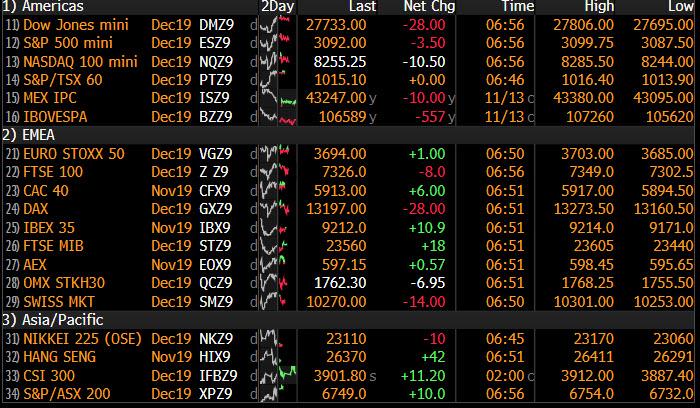
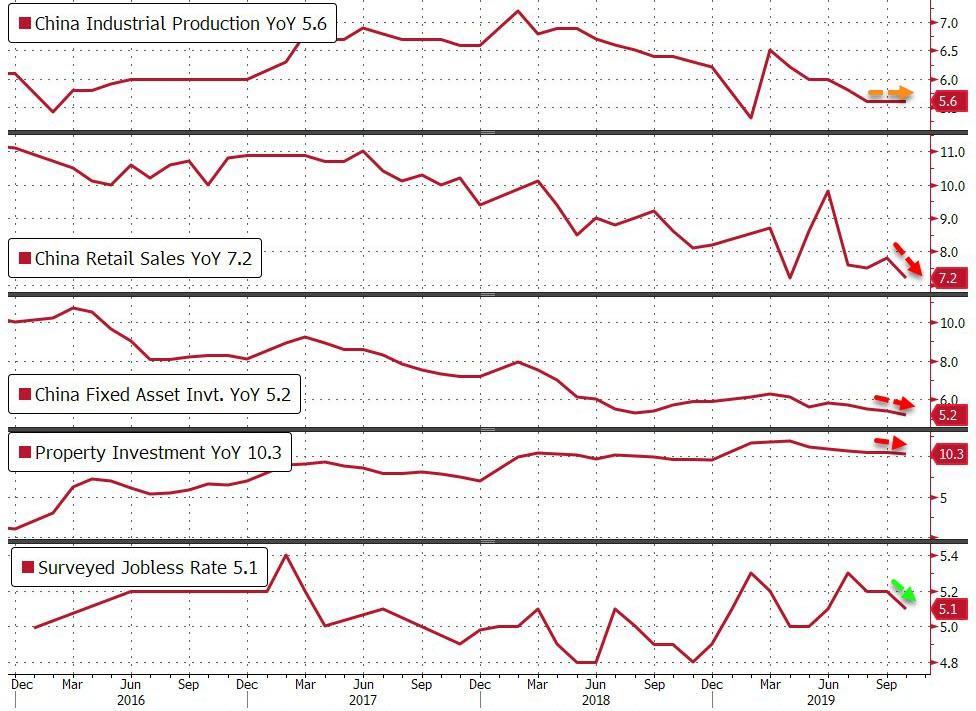
Global stocks and US equity futures eased further on Thursday as the latest dismal Chinese data missed across the board and showed further economic slowdown, with investment growth printing weakest since 1998...


... adding to worries about the global growth fallout from the U.S.-China trade war. U.S. futures were down 0.14%, following a record-high close on the S&P 500 on Wednesday. Futures bounced briefly after news that China customs have lifted restrictions on US poultry meat imports, with China's Global Times acknowledging saying the move comes "amid the continuation of tradetalks, paving the way for hundreds of millions of dollars worth US meat export to China"; the US exported $390MM worth of poultry to China in 2014 before the ban. Yes, million, not billion.


With earnings season ending, Cisco Systems tumbled in early trading after its quarterly sales forecast fell far short of projections, while WalMart surged after the company raised its full year outlook. Altice Europe NV beat earnings estimates, while Burberry Group Plc climbed after reporting six-month earnings that exceeded expectations.

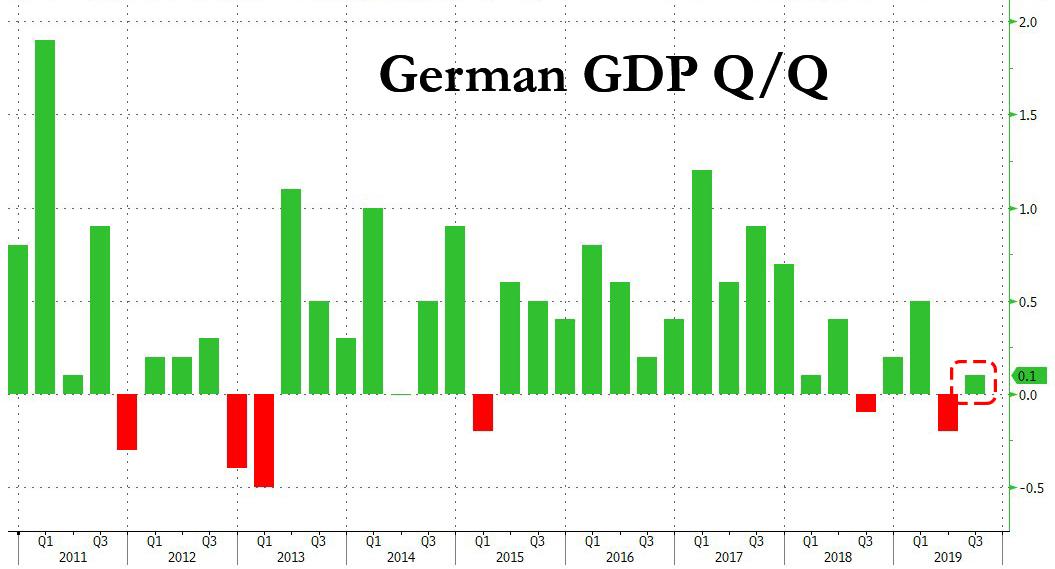
The MSCI All-Country World index was down 0.14% after start of trading in Europe. European shares initially fell, but later rebounded after data showing the German economy just barely missed a recession, rising 0.1% in the third quarter, avoiding a contraction thanks to consumer spending, and beating expectations of a second consecutive contraction.


While a recession was averted, the news was hardly good as Germany grew at just half the pact of the overall eurozone as growth across the entire continent grinds to a halt.

“Obviously it’s better than expected, but actually I would argue is that it’s a hollow victory because in effect it makes a fiscal response less likely,” said Michael Hewson, chief markets analyst at CMC Markets in London. “I think if they’d gone into a technical recession, the pressure to loosen the purse strings so to speak would have been much much greater.”

In Asia, stocks fell after very poor economic data in China and Japan showed the trade war between Beijing and Washington was hitting growth in some of the world’s biggest economies. MSCI’s broadest index of Asia-Pacific shares outside Japan fell 0.3%, while Japan’s Nikkei index fell further, dropping 0.8%. Asian stocks slid for a second day, led by material producers, as China’s economy slowed further in October, with factory output, retail sales and investment all below estimates. Most markets in the region were down, with Japan leading declines. The Topix fell 0.9%, dragged down by Sony and Toyota Motor, as Japan’s economy slowed sharply in the third quarter amid shrinking exports. Q3 GDP in Japan printed at just 0.1% - the same as Germany - and missing estimates of 0.2%.

- Source, ZeroHedge, read more here

Wednesday, 13 November 2019

Rob Kirby: Amount of Money Fed Into System Now Too Hard to Hide


The gold and silver market being flooded with paper shorts is yet another sign that time is short. Kirby says the elite want people to think gold and silver are bad investments, but he says don’t believe it, and “do not sell it.” 

Macroeconomic analyst Rob Kirby goes on to warn, “Gold and silver are historically alternatives to a failing fiat currency regime. 

The U.S. dollar is failing in front of our eyes. We know that because we know that $21 trillion extra (on top of the $23 trillion national debt) was created, and we know what they are doing with it. Part of that $21 trillion is being used to knock the price of gold and silver down with paper contracts. 

This is not a winning strategy, and this will ultimately blow up in their face too. They are being done to buy time and make the dollar appear strong.

The way this has to end is the U.S. dollar will go to its real intrinsic value, which is zero. That implies a hyperinflationary experience at some point in time, and it could be soon.

The amount of money being fed into the system is soon going to be too hard to hide.”

- Source, USA Watchdog

Russia to cut share of U.S. dollar in National Wealth Fund, mulls other currencies


Russia will reduce the share of the U.S. dollar in its National Wealth Fund and is considering investing in other foreign currencies including the Chinese yuan, Deputy Finance Minister Vladimir Kolychev said on Wednesday.

Kolychev confirmed a Reuters report from earlier this month that Russia was planning to diversify its foreign currency holdings in 2020.

Kolychev said the move was in part meant to shield Russian reserves from external risks. He did not give an exact figure for what the U.S. dollar’s share would be trimmed to in the National Wealth Fund.

The U.S. unit made up about 36% of the National Wealth Fund, or $124.5 billion, as of end-October, according to Reuters calculations based on finance ministry data.

“Geopolitical risks are one of the key factors in determining the structure of the National Wealth Fund,” he told reporters on the sidelines of a conference in central Moscow.

Russia had stepped up what it calls a de-dollarization process to reduce its dependence on the U.S. currency when Moscow’s relations with the West deteriorated over Russia’s annexation of Crimea in 2014 and its role in the Ukrainian crisis.

“I can say with certainty that the U.S. dollar share will be smaller,” Kolychev said. “Different currencies are being considered... including the yuan.”

The structure of Russia’s international reserves has already changed and the planned changes to the National Wealth Fund will bring its composition closer to that of the central bank’s foreign currency reserves, Kolychev said...

- Source, Reuters, read more here

Swiss National Bank Now Owns Record $94 Billion In US Stocks After Q3 Buying Spree

In the third quarter of 2019, one in which the global economy continued to cycle lower, global central banks across the world continued to slash interest rates and launched/expanded quantitative easing programs with very little success at troughing global growth. Still, US equity indices powered to new highs, climbing a wall of worry of President Trump's "trade optimism" tweets.

It seemed quite evident over the quarter that President Trump's tweeting of constant fake trade news and record stock buybacks juiced the market to new highs, however, what was really taking place was the Swiss National Bank (SNB) printing money out of thin air buying stocks with no regard for price or cost.

SNB's motive was to boost market confidence that a 2016-style rebound in the economy was imminent by sending stock indexes to new highs.

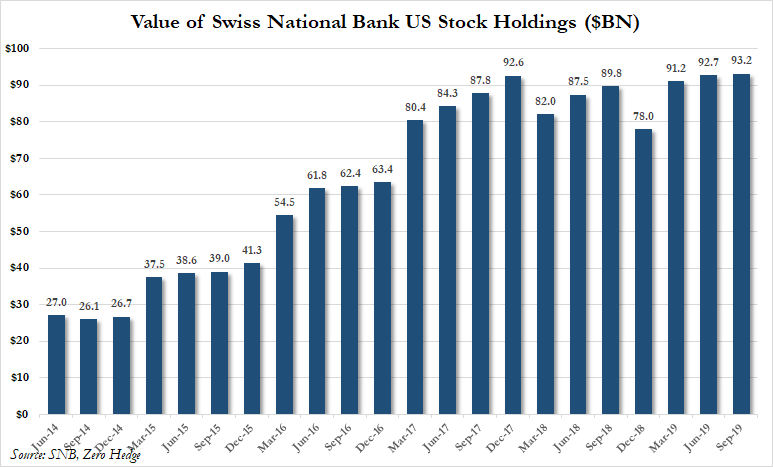
The SNB's latest 13F showed total holdings of US stocks have hit a record high, now valued at $94.1 billion, up 1.5% in 3Q.


Some notable observations: in the third quarter, after the SNB printed money out of thin air, it then added 1.28 million shares of BABA, 970K shares of FIS, 628K of JD, 537K of JNPR, 472K of GPN, and 257K of MSFT.

Other notable observations: it sold 1.85 million shares of FDC, -301K shares of ORCL, -229K shares of CSCO, and -188K shares of AAPL.


Top holdings continue to be AAPL (3.63% of total portfolio), MSFT (3.58% of total portfolio), AMZN (2.55% of total portfolio), FB (1.50% of total portfolio), and GOOG (1.34% of total portfolio).

SNB's asset allocation over the last six years has been heavyweight technology, healthcare, and consumer discretionary stocks.


SNB printing money out of thin air and buying a handful of stocks that push the broader equity market to new highs, has created an illusion that President Trump's "trade optimism" could lead to a global economic recovery. And when a global recovery doesn't come -- the trade war will be blamed.

- Source, Zero Hedge